Department installed applications include those that are still managed by IT staff or desktop administrators and delivered to users but are not included in a master image. ProfileUnity with FlexApp is enabled by the administrator for select users or groups within the ProfileUnity Management Console. Admins package applications that are provisioned on a virtual disk to run separately from the OS and local session. When users log in, these FlexApp applications appear beside their golden image applications.
Note: One of the most powerful features of ProfileUnity is the filters that can be leveraged during the assignment of FlexApp Layers. Note that filters apply only to cloud, VHDX, or local disk FlexApp packages/layers. VMDK-based FlexApp layers currently support user, group, and basic machine assignments. The primary reason for the difference in VHDX vs. VDMK package types centers on architecture. The ProfileUnity Configuration INI-based workflow does not apply to the VMDK-based assignments controlled by vCenter. For more information, refer to the FlexApp Using VHDXs vs VMDKs guide.
Starting the FlexDisk Service for VMDK-based Application Delivery
To use VMDKs for application delivery, complete the following steps:
- When installing the ProfileUnity Management Console, you were asked to pick a broker for the integration of the FlexDisk VMDK distribution technology. FlexDisk will govern the operation of the VMDK ProfileDisk whether you use Citrix, VMware, Microsoft WVD, or Other as your broker.
- Log in to the ProfileUnity Management Console.
- Hover over your username in the top right corner of the screen.
- In the drop-down menu that appears, click the Administration option.
-
Note: If you selected VMware as your broker, you must set up the FlexDisk service if you have not already done so. Follow the directions provided earlier in the Setting Up ProfileUnity Clustering for FlexDisk section.
- The Administration screen opens with the Settings tab displayed.
- Scroll down to the Client Settings section.
- Set ProfileDisk and FlexDisk VMDK Mode to FlexDisk VMDK ProfileDisk and FlexApp.
- Set the Deployment Path to your NETLOGON path.
- Click the Update button in the top right corner of the Management Console screen.
- Click the Download or Deploy Client Settings button to send a copy of the client configuration file to the specified location.
- On the screen that pops up, select the Platform for deployment.
- If you choose the Domain or Cloud option, this places the client configuration file in the directory you specified for the Deployment Path.
- If you are not logged in as an Active Directory user, choose the Download option. This allows you to place the client configuration file, clientsettings.xml, in the Deployment Path manually.
- Click the Deploy button.
- Scroll down to the ProfileUnity Tools section and click Download or Deploy Client Tools to copy the ProfileUnity Client files to the NETLOGON share on your domain controller.
- Click the Configuration Management option in the left column.
- In order for the FlexDisk Service to work, you must have at least one ProfileUnity Configuration File (INI) downloaded to your Deployment Path. In order to configure FlexDisk without other configuration settings, create a blank configuration file in the Configuration Wizard by choosing a Manual configuration with no other settings in it.
- Reboot or refresh all user desktops. If Microsoft® .NET Framework is not installed in the base operating system on a particular desktop, ProfileUnity will install it after the desktop restarts. The installation of .NET will increase the time it takes before the desktop is available again.
- The next step is to install the FlexApp Packaging Console in a separate location.
Installing the FlexApp Packaging Console and Packaging Applications
The FlexApp Packaging Console allows administrators to configure and prepare any applications that will need to be configured for users and made available as a department installed application. This software can be downloaded from the ProfileUnity Management Console and installed on a separate machine for packing applications. For more information on installing and using the FlexApp Packaging Console, refer to the ProfileUnity FlexApp Packaging Console Guide.
When using the FlexApp Packaging Console to create VMDK-based application packages, select FlexDisk as the Package Type and choose which FlexDisk datastore to which the package will be saved.
Assigning VMDK-Based FlexApp Layers to Users, Groups, or Computers
After applications have been packaged on the appropriate 32-bit or 64-bit OS platform using the FlexApp Packaging Console, the ProfileUnity Management Console enables admins to set which applications are assigned to which users, user groups or computers. Computer-level assignments allow for pattern-based machine name matching to cover a pool of machines rather than a single machine. VMDK-based FlexApp packages can be used with or without ProfileUnity as a Service. If ProfileUnity as a Service is used, FlexApp packages are played back on service boot making them available before the user logs in. If ProfileUnity as a Service is not used, playback of the FlexApp packages occurs at user login. However, no user assignments are needed in this case which might be valuable in a lab scenario where many users have access to log in to a finite pool of computers.
- Click the FlexDisk Management option in the left column.
-
-
Note: Beginning with version 6.8.5, FlexDisk Management is hidden by default. If you do not see it in the left column, click your username in the top right corner of the screen and click the Administration option. In the Settings tab, scroll down to and click to open the Miscellaneous section. Deselect the Hide FlexDisk checkbox, then click Update in the top right corner of the screen. Lastly, refresh your screen and the FlexDisk Management option should appear in the left column.
-
- The FlexDisk Management screen opens with the FlexApp tab displayed.
- Click the
 (Assignments) button for each FlexApp VMDK that needs to be assigned to users.
 - Either search Active Directory to select a user or group from the list for user assignments, or enter a machine name pattern for computer-level assignments. If you have VMware Horizon and have installed the Connection Service Monitor, you will get the option to limit the application to the user, group, computer and/or the pool. Click the Add Assignment button to add it to the list of current assignments.
-
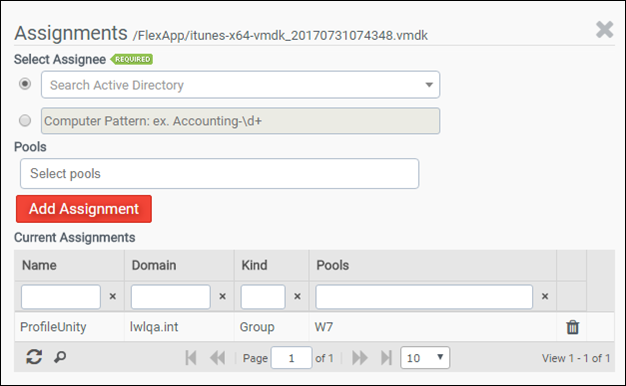
- Click the X icon to close the screen.
Viewing VMDK-Based FlexApp Packages in the Management Console
To see your FlexDisk packages, click the FlexDisk Management option in the left column. All VMDK-based packages appear in the FlexApp tab on the screen.
-
-
Note: Beginning with version 6.8.5, FlexDisk Management is hidden by default. If you do not see it in the left column, click your username in the top right corner of the screen and click the Administration option. In the Settings tab, scroll down to and click to open the Miscellaneous section. Deselect the Hide FlexDisk checkbox, then click Update in the top right corner of the screen. Lastly, refresh your screen and the FlexDisk Management option should appear in the left column.
-