Prerequisite: Before proceeding with the following steps, you must have bundled the _StartupIntuneFA1s.cmd script into an Intune Win32 package.
This section covers how to add the IntuneWin package you created in the previous chapter as a Win32 application. An example name would be something like _StartupIntuneFA1s.cmd.intunewin.
This script bundled as an IntuneWin will be installed only if an application is synced to the ProgramData\FlexAppOne\Startup folder. This should be deployed along with the FlexApp One Service so it is ready to run in the event of an application needing to be layered and registered with the system at boot. For detailed information, refer to the section of this guide on adding an app to the startup folder.
To add the IntuneWin package you created previously as a Win32 application, complete the following steps:
- Open Microsoft Intune admin center.
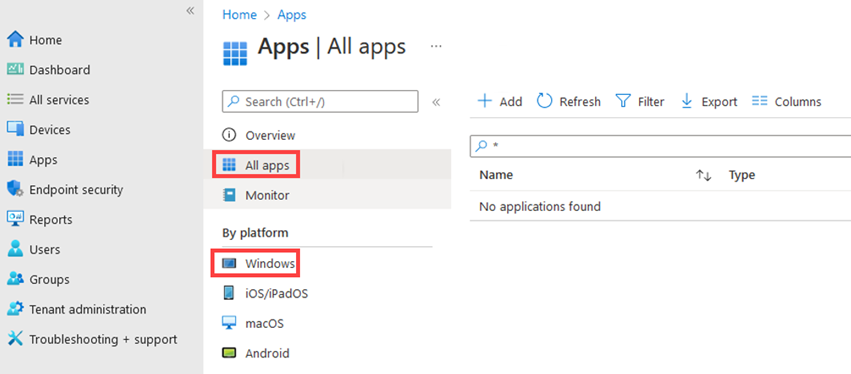
- In the left column, click the Apps option.
- In the Apps screen that opens, select All apps or Windows.
-
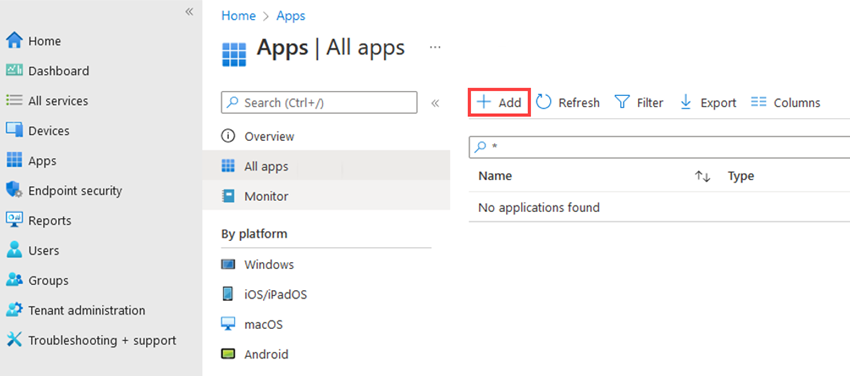
- In the field to the right of the All apps and Windows options, click the Add button.
-
- In the Select app type region that opens on the right, in the App type field, select Windows app (Win32).
-
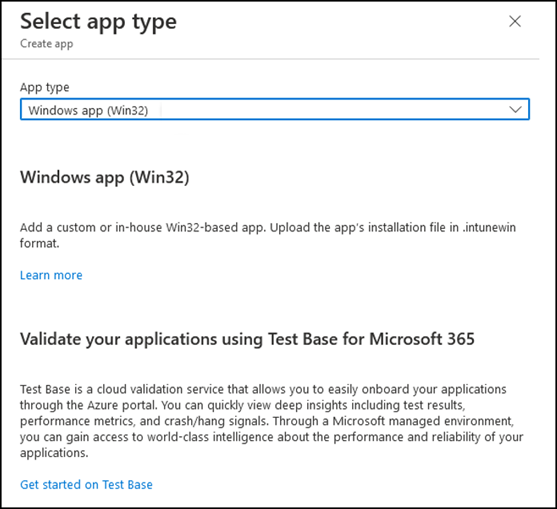
- Click the Select button at the bottom of the Select app type screen.
- The Add App wizard opens.
- Click the Select app package file link.
-
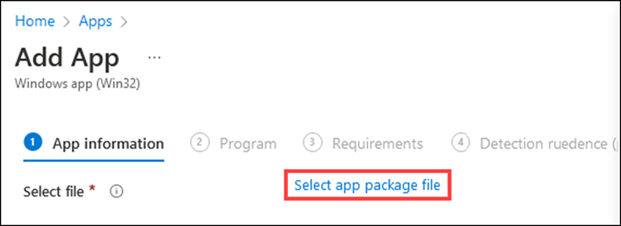
- The Add package file field opens.
- Click the folder icon, then navigate to your IntuneWin package, select it, and click the OK button.
App information Section
- In the App information section of the Add App screen, enter the following information:
- Name —For example,
_StartupIntuneFA1s - Description
- Publisher
- Version —This should match the version of the file name
- Name —For example,
- In the Show this as a featured app in the Company Portal field, select No.
- Click the Next button to proceed to the Program section.
Program Section
- In the Program section of the Add App screen, enter the following information:
- Install command:
_StartupIntuneFA1s.cmd - Uninstall command:
_StartupIntuneFA1s.cmd uninstall - Install behavior: Select the System option.
- Under normal circumstances, you should leave the rest of the options set to their default values.
- Install command:
- Click the Next button to proceed to the Requirements section
Requirements Section
- In the Requirements section of the Add App screen, enter the following information:
- Operating system architecture: 64-bit
- Minimum operating system requirement: Windows 10 1607
- Under normal circumstances, you should leave the rest of the text fields set to their default values.
- Under the Configure additional requirement rules section, click the Add button.
- In the Add a Requirement rule field that appears on the right, enter or select the following values:
- Requirement type: File
- Path:
C:\ProgramData\FlexAppOne - File or folder: Startup
- Note that this folder will not exist until you sync a FlexApp One to this Startup folder in a future step.
- Associated with a 32-bit app on 64-bit clients: No
- Click the Next button to proceed to the Detection rule section.
Detection rule Section
- In the Rules format field of the Detection rule section, select the Manually configure detection rules option.
- Click the Add link.
- Select the File option in the Rule type field.
- In the Path field, enter the following:
-
Copy
C:\ProgramData\FlexAppOne\Startup - In the File or folder field, enter Logs.
- In the Detection method field, select the File or folder exists option.
- In the Associated with a 32-bit app on 64-bit clients field, under normal circumstances select the No option.
- Click the OK button.
- Back in the Detection rule section, click the Next button to proceed to the Dependencies section.
Dependencies Section
Note: If you install your FlexApp One Service via a script or other method (Microsoft Intune PowerShell module installs PowerShell scripts first), you do not need to tie each application to a dependency of the FlexApp service. This could help you swap out your FlexApp service later without needing to use supersede or remove the dependency from each application.
- Click the Add button.
- Choose your FlexApp One Service application, then click Select.
- Click the Next button to proceed to the Supersedence section.
Supersedence Section
- In the Supersedence section of the Add App screen, under normal circumstances you should leave the fields blank.
- Click the Next button to proceed to the Assignments section.
Assignments Section
Note: The Client will have to choose to use required or available for enrolled devices. They can add a group like Sales and assign many apps to Sales, or they can add a device name, or you can add a per App group name. These instructions will use the per App group name for this process.
- In this step, you will force the application instead of allowing the user to choose the app from the Company Portal. To allow the customer to choose the application from the Company Portal, you must move the group from Required to Enable for Enrolled. In this example case, the result will look something like this:
-
Required (Pushed/Forced): (Comm) FlexApp One Service
-
Enable For Enrolled - On Demand/Company Portal: Nothing
-
Uninstall: (DeComm) FlexApp One Service
- In the Required section of the Add App screen, click the Add group link.
- On the Select groups screen that opens, filter your groups down to your commission control group by entering
(Comm)in the search field. - In the options list that appears, click to select your commission control group, which should have a name like (Comm) FlexApp One Service (Your FlexApp Service Group Name No Version or Extension).
- Click the Select button at the bottom of the Select groups screen.
- In the Uninstall section of the Add App screen, click the Add group link.
- On the Select groups screen that opens, filter your groups down to your decommission control group by entering
(DeComm)in the search field. - In the options list that appears, click to select your decommission control group, which should have a name like (DeComm) FlexApp One Service (Your FlexApp Service Group Name No Version or Extension).
- Click the Select button at the bottom of the Select groups screen.
- (Optional) To prevent notifications from showing on the client side, complete the following sub-steps:
- Click the End user notifications option.
- Click the Show all toast notifications option.
- In the End user notifications section, select the Hide all toast notifications option. This is an organizational preference and does not need to be set different from the default.
- Click the Next button to proceed to the Review + create section.
Review + create Section
- In the Review + create section of the Add App screen, review your settings then click Create.
- The _StartupIntuneFA1s.IntuneWin package is then uploaded to the cloud.